


%20(1).png)


Before you can get ISO 27001 certified, you need more than just policies on paper. What you need is proof that the right controls and mandatory documents are in place. That means understanding exactly where you stand today against ISO 27001 standards.
An ISO 27001 gap analysis, a precursor to certification, is the best way to do this. It helps you systematically review your current policies, controls, and processes to spot shortcomings and fix them before the certification audit.
In this article, we explain what the ISO 27001 gap analysis is and show you how automation tools and templates can simplify your assessment to help you prepare for certification audits with confidence and clarity.
What is an ISO 27001 gap analysis, and why does it matter?
An ISO 27001 gap analysis is a structured assessment of your organization’s current information security practices. It benchmarks your existing security policies, processes, and controls against ISO 27001 requirements, highlighting areas that fall short of the standard.
The insights from this exercise serve as a roadmap to strengthen your information security framework.
The gap analysis is often one of the first steps in the ISO 27001 implementation project, leading to certification. It gives you clear visibility into audit readiness and delivers prioritized recommendations for remediation.
This not only accelerates the ISO 27001 certification process but also builds a stronger, more resilient information security posture.
Key phases of an ISO 27001 gap analysis
A structured ISO 27001 gap analysis helps organizations pinpoint compliance gaps, assess risks, and build a clear roadmap toward certification readiness.
Each phase focuses on specific activities from scoping and evidence gathering to reporting, helping you accelerate ISO 27001 readiness.
1. Scope definition
The first step is setting ISMS boundaries by identifying business units, processes, assets, and stakeholders to be assessed. It helps you align your ISO 27001 gap analysis with organizational objectives, the risk environment, and regulatory requirements.
- Identify business units, processes, and assets, including teams handling sensitive data, that need to be covered by ISO 27001 standards.
- Specify inclusions, exclusions, and dependencies.
- Engage with stakeholders and assign responsibilities.
- Document the scope and establish a clear roadmap for assessing ISO 27001 readiness.
2. Policy and control review
The policy review checks whether you maintain mandatory ISO 27001 documents as proof of your compliance. These include policies, procedures, records, and decisions tied to your ISMS, covering everything from risk assessments to internal audits.
- Collect the required documents, such as information security policy, risk assessment methodology, risk treatment plan, incident response, access control policies, and more.
- Review each document for accuracy and completeness as per the requirements of the ISO 27001 clauses.
- Confirm documents are current, version-controlled, and approved by management.
Identify inconsistent or outdated policies.
This step highlights documentation gaps and ensures your ISMS framework is adequately supported before moving into control-level analysis.
The control review focuses on identifying fully, partially, or non-implemented controls, providing a baseline of current security maturity against ISO 27001 requirements.
- Assess if the justifications for excluded or deemed “not applicable” controls are reasonable. It will enable you to identify any missing control and ensure all relevant controls have been implemented.
- Evaluate if the implemented controls work effectively and operate as intended.
- Analyze if the implemented controls are sufficient to meet your organization’s security risks and operational requirements.
- Identify gaps where controls are missing or ineffective.
3. Evidence gathering
Collect artifacts that prove the existence and effectiveness of your controls. These can include audit logs, incident management tickets, training records, and third-party vendor contracts.
Strong evidence collection ensures your findings are based on reliable data, shows compliance maturity, and leaves behind an auditable trail of documentation.
4. Gap documentation
Translate your findings into a structured gap analysis report. This should capture each gap, its potential impact, and the corresponding remedial action plan.
From there, create a prioritized roadmap with timelines, responsibilities, and resource needs. This approach not only addresses immediate risks but also strengthens your ISMS maturity and prepares you for ISO 27001 certification audits with confidence.
5 common mistakes teams make during an ISO 27001 gap analysis
Even with the best intentions, many organizations stumble when conducting an ISO 27001 gap analysis. The good news? Most of these mistakes are avoidable, and fixing them saves both time and effort.
1. Poor scope definition
Audit risk increases if you fail to define the scope of your analysis properly. A scope that’s too narrow leaves out business units, processes, or assets, creating blind spots. Too broad, and you waste time analyzing systems irrelevant to certification like those that never handle sensitive personal data.
2. Lack of skilled personnel
Conducting an ISO 27001 gap analysis requires extensive knowledge of the standard and its application to your organization. Without qualified professionals, you risk missing critical gaps in your ISMS, which can lead to suboptimal remediation, making your organization vulnerable to threats.
If you lack trained resources, consider partnering with consultants or deploying automated solutions.
3. Relying on generic checklists
Teams often use off-the-shelf checklists or templates without customizing them to organizational specifics. With generic checklists or templates, organizations miss business context and unique risks, leading to incomplete assessments. Tailoring your approach ensures findings are relevant and actionable.
4. Inadequate documentation
Incomplete documentation of assessment findings, remediation plans, and implemented controls impedes audit preparation. The lack of proper documentation can lead to flawed assumptions derailing your remediation efforts.
To avoid this, ensure critical documents like the Statement of Applicability (SoA), incident logs, and policies such as access control are accurate, complete, and up to ISO 27001 standards. Gaps should be clearly logged for follow-up.
5. Insufficient stakeholder engagement
Failing to involve key stakeholders limits the perspective, which may cause you to miss risks specific to departments or business processes. Besides, the team may resist new controls or processes, jeopardizing your efforts in implementing the recommendations.
Involve relevant department heads early in decision-making and train staff to help facilitate adoption.
Manual vs. automated gap analysis
Manual and automated gap analysis methods offer distinct benefits and challenges in assessing your organization's ISO 27001 compliance status and audit readiness. The two methods differ in accuracy, speed, and resource requirements. Manual methods allow for customized analysis and contextual judgment, while automation delivers faster, consistent results at scale.
How Scrut simplifies the ISO 27001 gap analysis process
Scrut streamlines ISO 27001 gap analysis by automating control mapping, evidence collection, and reporting. Its dashboards and reports centralize and visualize data from different departments for a streamlined monitoring and verification process.
Here’s how Scrut simplifies the ISO 27001 gap analysis:
1. Automated control mapping
Scrut maps your existing security controls, processes, and policies against ISO 27001 requirements and Annex A controls. This reduces manual effort, ensures consistency, and quickly highlights compliance gaps.
2. Automated evidence collection
The platform integrates with your tech stack (cloud platforms, HR systems, ticketing tools, etc.) to automatically collect evidence and simplify control verification. The automation improves efficiency and audit-readiness.
3. Pre-built ISO 27001 document templates
Access Scrut’s library of ready-to-use, auditor-approved templates for all mandatory ISO 27001 policies and procedures.
These templates streamline the policy review process and simplify documentation, helping organizations stay audit-ready with less effort.
4. Real-time gap visibility
The dashboard provides a clear, centralized view of your ISO 27001 compliance status, enabling you to identify gaps and critical issues in real-time. You can monitor key ISO 27001 controls, system changes, and policy compliance.
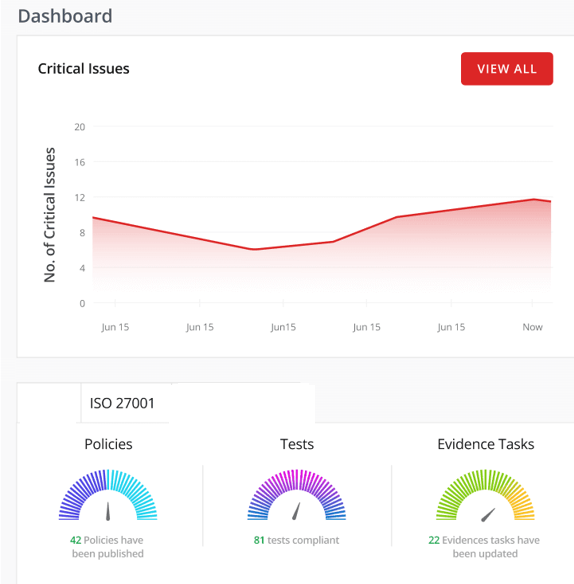
You can see the percentage of compliant controls, track the progress of individual policies, evidence, and tests, and monitor open action items.
5. Centralized ISO 27001 documentation management
Instead of managing documents across spreadsheets or folders, Scrut provides a single platform to store, update, and track all ISO 27001 documents with version control, ownership, and approval workflows. It eliminates the need for manual tracking across multiple tools.
This unified view provides visibility into document status and gaps, allowing teams to stay continuously audit-ready without scrambling for documents.
6. Automated test to identify gaps
Leverage hundreds of prebuilt tests to identify gaps against ISO 27001 controls. The platform runs daily automated tests that detect misconfigurations in real time. Failed tests come with clear remediation guidance to enable you to resolve issues before they can impact your audit.

Schedule a Scrut demo today to see how Scrut accelerates ISO 27001 readiness.

%201.png)