


%20(1).png)
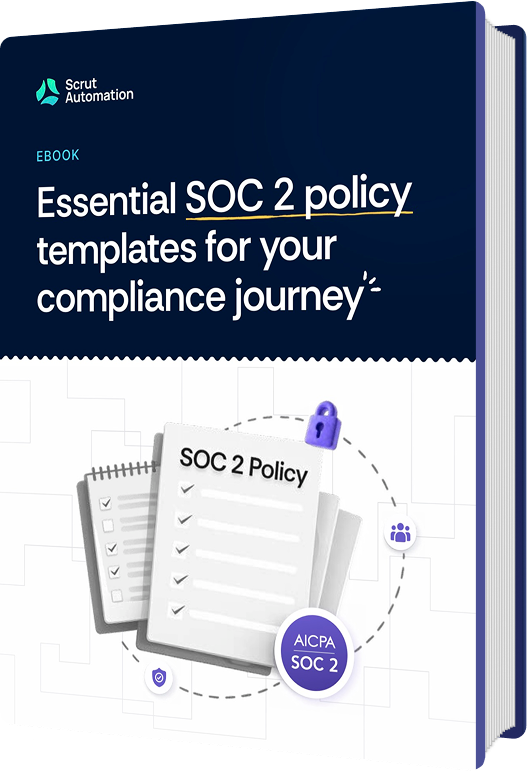
Essential SOC 2 policy templates for your compliance journey
The policy set auditors actually examine, tiered by what matters
For GRC leads, CISOs, and heads of security scoping their SOC 2. 25 policy templates organized by audit criticality, with the audit realities that determine whether they hold up.

Description
Here's what catches many teams off guard: the AICPA does not provide an official library of SOC 2 policy templates. Every organization is left to interpret the Trust Services Criteria on its own, and the real trap isn't finding documents. It's deploying inconsistent or unenforceable language that creates gaps between what your policies promise and what your team actually does.
This ebook gives you a foundational set of 25 SOC 2 policy templates, prioritized by audit criticality and business impact. Twelve critical policies that anchor the mandatory Security criteria. Seven important policies that enterprise buyers expect in deal cycles. Six recommended policies that signal maturity. Each one covers its purpose, what it includes, and why auditors care.
You also get the six audit realities to know before deploying any template, a customization checklist for SaaS environments, and the policy, procedure, control, evidence chain that determines whether a well-written document survives an actual audit.
Here are the insights you will walk away with

Why Security criteria are mandatory in every audit, and the data showing Confidentiality nearly doubled in one year, from 34% of SOC 2 reports in 2023 to 64.4% in 2024.
Twelve critical, seven important, six recommended. Start with the audit foundation, then add tiers as customer expectations evolve, without overwhelming your team.
Auditors test controls against policy promises. If your policy says access is reviewed every 30 days and the process runs quarterly, that's an audit exception.
From information security and access control to secure SDLC and vendor risk, each with purpose, contents, and why auditors care, plus a linked template.
Too many policies create commitments you can't maintain. Too few signal immaturity and invite deeper scrutiny in vendor risk assessments. How to find the balance.


Get access to the ebook now
These are the questions this eBook will answer
There is no official AICPA list, but every SOC 2 audit tests the Security criteria, which require foundational policies covering governance, risk assessment, access control, and incident response. This ebook organizes the full set into 12 critical, 7 important, and 6 recommended policies.
No. The AICPA defines the Trust Services Criteria but does not publish a policy template library. That gap is why teams end up with inconsistent or unenforceable language, and why this guide prioritizes templates by audit criticality instead.
It depends on your scope. A Security-only audit needs roughly 12 foundational policies. Add Availability and Confidentiality, common in enterprise deals, and you're closer to 19. The right number is the set your team can actually maintain, because every policy is a commitment to auditors.
They're a starting point, not a finish line. Free templates typically miss TSC mapping, control cross-references, ownership matrices, evidence guidance, and version control workflows. An audit evaluates whether you follow your policies, not whether you have them.
A policy is the high-level mandate (all employees must use MFA). A procedure is how it's done. A control is the mechanism enforcing it. Evidence is the proof it occurred. If any link in that chain breaks, the auditor may find the control ineffective regardless of how well the policy is written.