


%20(1).png)
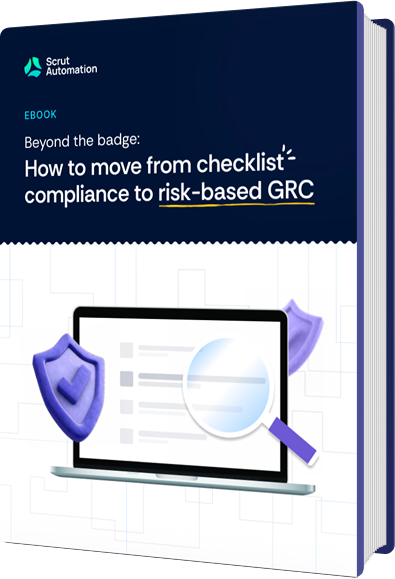
Beyond the badge
How to move from checklist compliance to risk-based GRC
For security leads, compliance owners, and founders who passed the audit but don't feel more secure. Learn how to build a GRC program that tracks real risk, not audit calendars.

Description
"We passed SOC 2, but nothing actually feels more secure." Most teams know this feeling. The badge is live, the report is filed, and yet controls sit on paper while risk quietly builds in systems that change every day.
This ebook explains why compliance breaks in real SaaS environments and what to do about it. It introduces the signal to risk to control to evidence model, the missing layer most GRC programs never build, and shows how to run risk-based GRC without hiring a bigger team. You get a practical six-step decision model, a self-assessment to test how checklist-driven your program really is, and a 90-day roadmap to make the shift.
If your compliance program proves controls exist but can't prove they work, this one is for you.
Here are the insights you will walk away with

The three cracks that form in every checklist-driven program: the checklist trap, the hidden manual layer, and the engineering reality mismatch.
How the signal-to-risk-to-control-to-evidence model turns compliance from static documentation into a live reflection of your security posture.
Seven indicators that your program is still checklist-driven, with a scoring rubric to tell you exactly where you stand.
How to move to risk-based GRC step by step, from starting with real system signals to automating only what reduces effort.
What to stop doing immediately, and what to change in days 0 to 30, 30 to 60, and 60 to 90. No rebuild required.


Get access to the ebook now
These are the questions this eBook will answer
Risk-based GRC means prioritizing controls based on actual system risk rather than audit checklists. Instead of starting with a framework and working backward, you start with what can realistically disrupt your systems or expose your data, then design controls to reduce that exposure. Frameworks get mapped later.
Checklist compliance begins with controls, runs on annual cycles, and relies on static evidence collected before audits. Risk-based compliance begins with risk, runs continuously, and depends on live system signals. One proves controls exist. The other proves they work.
Compliance validates controls over a defined audit period, but risk keeps evolving as systems, users, and environments change. Controls can pass an audit and still fail under real conditions. This ebook covers how to close that gap with continuous validation.
You don't need a larger compliance function. The ebook lays out an ownership model where engineering owns signals, security interprets risk, and GRC maps controls to frameworks, so evidence is generated by systems instead of chased by people.
Yes, if controls are designed around risks rather than framework categories. A well-designed control, like periodic access reviews enforcing least privilege, can satisfy SOC 2, ISO 27001, and GDPR at once. The ebook explains how to build a control system, not a framework system.