CMMC Final Rule explained: What DoD contractors must prepare for now
The landscape of national security is no longer confined to physical borders; it extends deep into the digital infrastructure of every partner and supplier. The Department of Defense (DoD) has long recognized that the sensitive data handled by the defense contractor ecosystem, the Defense Industrial Base (DIB), represents a critical, vulnerable front. To address this evolving threat, the DoD formalized a robust framework: the CMMC final rule (Cybersecurity Maturity Model Certification).
This rule, officially implementing the CMMC Program, fundamentally changes how cybersecurity compliance is verified for companies that process, store, or transmit Controlled Unclassified Information (CUI) or Federal Contract Information (FCI). It mandates a structured, verifiable approach to cyber hygiene, replacing the previous self-attestation model with a tiered assessment system. As former FBI Director Robert Mueller observed, "There are only two types of companies: Those that have been hacked, and those that will be."
The CMMC final rule is the government’s comprehensive response, ensuring that defense contractors possess the demonstrable security controls necessary to deny that opportunity and protect the nation's invaluable information assets.
What is the CMMC Final Rule?
The CMMC final rule is the official regulatory framework, published in the Federal Register (32 CFR Part 170 and 48 CFR), that mandates and verifies the implementation of specific cybersecurity standards across the Defense Industrial Base (DIB). This framework officially adopts the CMMC model 2.0, simplifying compliance into a three-tiered structure: Level 1 (Foundational), Level 2 (Advanced), and Level 3 (Expert). This streamlined approach replaces the complexity of earlier drafts, focusing rigor where necessary.
CMMC 2.0 serves as the DoD’s crucial enforcement mechanism. While the existing Defense Federal Acquisition Regulation Supplement (DFARS) 252.204-7012 clause contractually obligates contractors to implement the security controls detailed in NIST 800-171 for protecting CUI, CMMC Level 2 now requires verifiable proof of that compliance.
This level, aligned precisely with the NIST 800-171 requirements, necessitates a mandatory third-party assessment (Certified Third-Party Assessor Organization or C3PAO) or a government-led assessment for many contractors. The final rule transforms cybersecurity compliance from an honor system under the old DFARS 7012 into a prerequisite certification for participating in DoD acquisition.
What is the CMMC implementation timeline, and how do its phases follow a staged approach?
The CMMC implementation timeline is structured in a deliberate, multi-year progression to ensure the DIB can adapt to the new regulatory requirements. This staged introduction is governed by the rule's effective date and outlines specific CMMC rollout phases for DoD contracts.
- Rule effective date: The official commencement of the CMMC Program acquisition rule (48 CFR) was set for November 10, 2025, following a 60-day period from the final rule’s publication. This date initiates the four-phase rollout.
- Phased contract inclusion: The inclusion of CMMC requirements in DoD contracts is not immediate but incremental, ensuring a smooth transition across the DIB.
- Initial assessment timeline (Phase 1): Since November 10, 2025, CMMC requirements have been included in selected new contracts.
- Compliance largely relies on self-assessments (Level 1 and certain Level 2 contracts).
- The assessment results must be recorded in the Supplier Performance Risk System (SPRS).
- Mandatory assessment timeline (Phase 2): Starting November 10, 2026, the assessment timeline shifts.
- Mandatory C3PAO certifications for CMMC Level 2 begin to appear in applicable contracts requiring the protection of CUI.
- Advanced implementation (Phase 3): Commencing November 10, 2027.
- This phase integrates CMMC Level 3 (Expert) requirements and the necessary government-led assessments (DIBCAC) for the most critical programs.
- Full implementation (Phase 4): Beginning November 10, 2028.
- CMMC requirements become universally mandatory, applying to all applicable DoD contracts, solicitations, option exercises, and renewals.
This structured approach demonstrates the DoD's commitment to verifiable cyber hygiene without overburdening the industry instantaneously.
What are the CMMC Levels under the Final Rule?
The CMMC final rule establishes three increasingly rigorous maturity levels, ensuring that a defense contractor's security posture is commensurate with the sensitivity of the information they handle.
4.1 Level 1 (Foundational)
CMMC Level 1 is designed for organizations that process or transmit Federal Contract Information (FCI), establishing basic cyber hygiene.
- Scope: Protection of FCI.
- Requirements: Compliance with 15 basic safeguarding practices, derived from the FAR 52.204-21 clause.
- Assessment type: Annual Self-assessment conducted by the Organization Seeking Assessment (OSA).
- Verification: Requires an annual affirmation of compliance submitted to the Supplier Performance Risk System (SPRS).
- POA&M Status: Not permitted. All 15 requirements must be fully met at the time of the assessment.
4.2 Level 2 (Advanced)
CMMC Level 2 is a widely applicable level that focuses on protecting CUI and introduces the formal verification process.
- Scope: Protection of Controlled Unclassified Information (CUI).
- Requirements: 110 security requirements, fully mapped to NIST 800-171.
- Assessment cycle: Triennial cycle (every three years).
- Assessment types: Varies based on the CUI handled:
- Annual Self-assessment for less critical CUI contracts (with annual affirmation).
- Third-party assessments by an accredited C3PAO for critical CUI contracts.
- POA&M Status: Limited use of Plans of Action and Milestones (POA&M) is allowed for conditional certification. Any non-critical deficiencies must be closed out within 180 days.
4.3 Level 3 (Expert)
CMMC Level 3 targets the most sensitive programs and addresses the threat posed by Advanced Persistent Threats (APT).
- Scope: Protection of CUI against Advanced Persistent Threats (APT).
- Requirements: Includes the 110 NIST 800-171 requirements plus 24 enhanced security requirements drawn from NIST 800-172.
- Assessment type: Government-led assessments conducted by the Defense Industrial Base Cybersecurity Assessment Center (DIBCAC).
- Assessment cycle: Triennial cycle (every three years).
- Prerequisite: Requires achieving a final CMMC level 2 certification (no open POA&Ms) before the Level 3 assessment can be initiated.
What’s new or different in the Final Rule
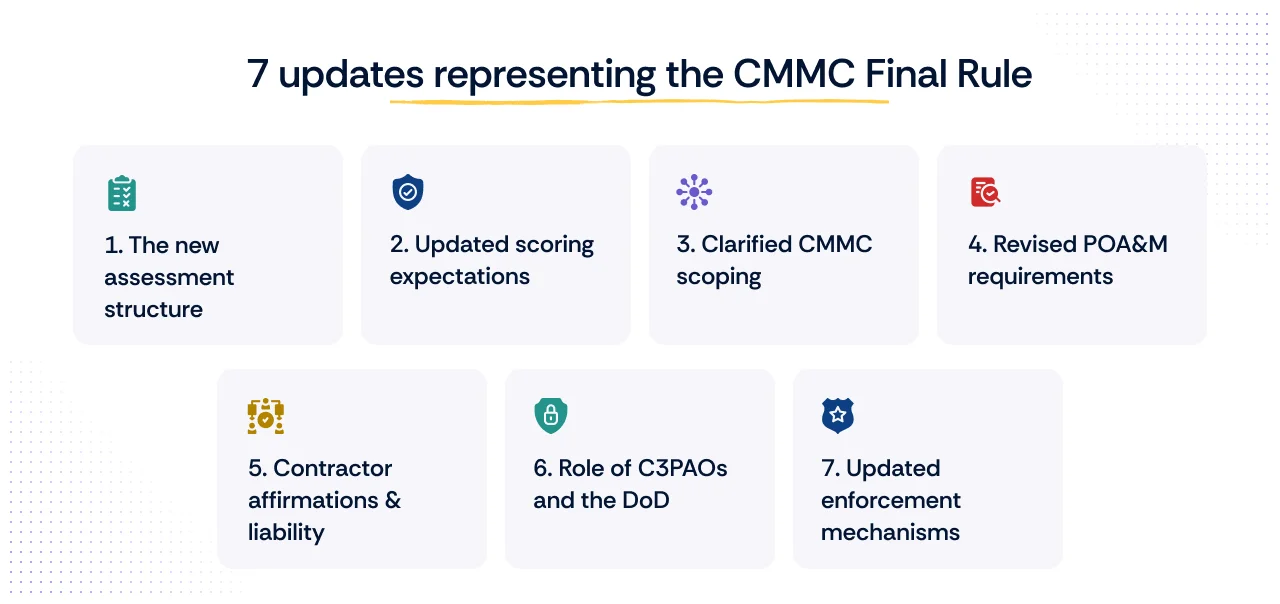
The CMMC final rule represents a critical evolution, moving beyond basic guidelines to establish a verifiable, legally backed security paradigm for the Defense Industrial Base. These definitive CMMC updates clarify ambiguities and formalize enforcement.
1. The new assessment structure
The model is streamlined from five to three levels, enabling flexibility at Level 2 (Advanced). This level offers two paths: the annual self-assessment for less sensitive CUI, and the triennial third-party assessment by a C3PAO for critical programs, ensuring that verification is proportional to risk.
2. Updated scoring expectations
Compliance is tied to a quantitative scoring system based on the 110 NIST 800-171 requirements. Controls are weighted with point values (typically 1, 3, or 5) based on their criticality to security. To receive conditional certification, an organization must achieve a minimum score, with critical 5-point requirements mandating full implementation at the time of assessment.
3. Clarified CMMC scoping
The rule provides definitive guidance for defining the CMMC Assessment Scope (CAS). This includes clarifying which assets are in scope (e.g., security protection assets) and explicitly detailing requirements for External Service Providers (ESPs), reducing industry uncertainty.
4. Revised POA&M requirements
The use of POA&M is strictly limited. It is not permitted at Level 1, and for Levels 2 and 3, any deficiencies allowed on a POA&M must be closed out within a firm 180-day deadline to achieve final status.
5. Contractor affirmations & liability
The rule mandates that a senior-level representative, the Affirming Official, electronically submits an annual affirmation of continuous compliance in SPRS. Knowingly submitting a false or inaccurate affirmation carries significant legal risk, including potential exposure under the federal False Claims Act.
6. Role of C3PAOs and the DoD
The new CMMC assessment requirements delineate clear responsibilities. C3PAOs conduct triennial Level 2 assessments and submit results to the CMMC eMASS environment, while the DoD's Defense Industrial Base Cybersecurity Assessment Center (DIBCAC) exclusively handles all Level 3 assessments.
7. Updated enforcement mechanisms
The ultimate enforcement mechanism is contractual eligibility. Failure to maintain the required CMMC status, including missing an annual affirmation or failing to close out a POA&M within 180 days, results in the contractor becoming ineligible for contract award or option renewal, triggering standard contractual remedies.
Compliance expectations under the final rule
Achieving CMMC certification is an exploratory endeavor requiring contractors to demonstrate not just intent, but verifiable and sustained security maturity. The final rule establishes strict expectations that assessors will enforce.
1. Mandatory documentation
The assessment hinges on comprehensive and current CMMC documentation. At Level 2 and 3, the foundational document is the System Security Plan (SSP), which details the system boundary and how each required control is met. The POA&M must also be documented for any allowable temporary gaps.
2. Minimum evidence expectations
Assessors demand robust cmmc evidence to prove controls are operating effectively. This includes policy and procedure documents, system audit logs, configuration settings, network diagrams, and personnel training records. The evidence must clearly demonstrate that the documented policies are being actively enforced within the CUI environment.
3. What assessors will check
Assessors will employ a three-pronged verification approach: they will review the documentation, conduct interviews with key staff (to ensure awareness and execution), and perform technical validation (e.g., spot-checking log retention, multi-factor authentication implementation) to ensure alignment with the SSP.
4. Continuous monitoring requirements
CMMC is an ongoing program, not a snapshot. The rule implicitly requires continuous monitoring through regular internal audits, ongoing vulnerability scanning, and timely remediation of issues. Controls must remain operational throughout the certification period (typically three years).
5. Annual affirmation requirements
To ensure perpetual compliance, the rule mandates an annual affirmation. A senior official must electronically certify that the organization continues to meet the applicable CMMC level, even in the years between triennial third-party assessments. This obligation is a non-negotiable component of the CMMC compliance checklist.
How the CMMC Final Rule impacts defense contractors
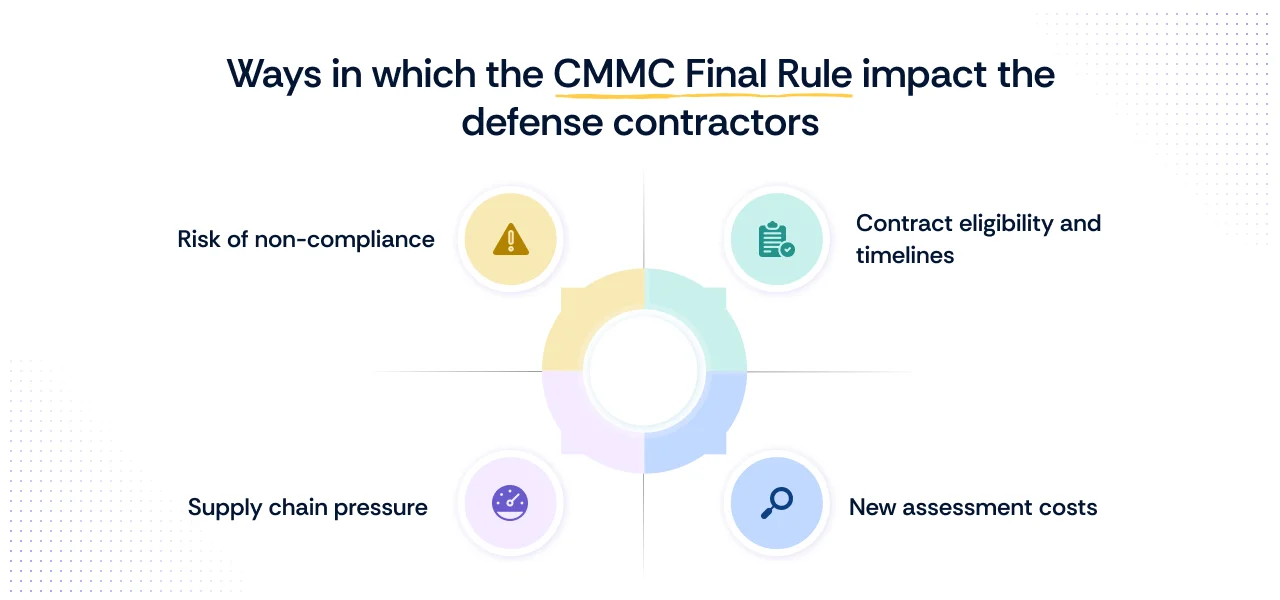
With the force of law, the CMMC Final Rule transforms the security posture of the DIB, elevating DIB cybersecurity from an aspirational best practice to an uncompromising barrier of entry for government engagement. This creates immediate and profound business implications for DoD bidders at every tier of the supply chain.
- Contract eligibility and timelines: CMMC certification is now a contractual prerequisite. Companies lacking the required CMMC status in the SPRS at the time of award are simply ineligible for new DoD contracts. Given the triennial assessment timeline for Level 2 and Level 3, delayed compliance means an immediate and protracted loss of business opportunity.
- New assessment costs: The rule mandates significant financial and resource investment. For a typical small-to-midsize business, the initial three-year cost for Level 2 compliance, encompassing gap assessments, technology remediation (e.g., MFA, encryption), and C3PAO assessment fees, can range from $63,000 to over $200,000. These new assessment costs must be factored into future bids.
- Supply chain pressure: The rule mandates flow-down requirements, placing acute supply chain pressure on prime contractors to verify their subcontractors’ compliance status. Primes are increasingly vetting suppliers months in advance, making CMMC certification a crucial competitive differentiator for all DIB organizations, regardless of size.
- Risk of non-compliance: The primary threat of non-compliance is the loss of contract revenue, but the legal exposure is far greater. Knowingly submitting a false or inaccurate CMMC affirmation to the government, or maintaining a demonstrably flawed security posture, exposes the company to severe legal liability under the False Claims Act (FCA). Penalties include triple damages, massive fines, and suspension from future federal contracting.
How to prepare now to implement the CMMC Final Rule
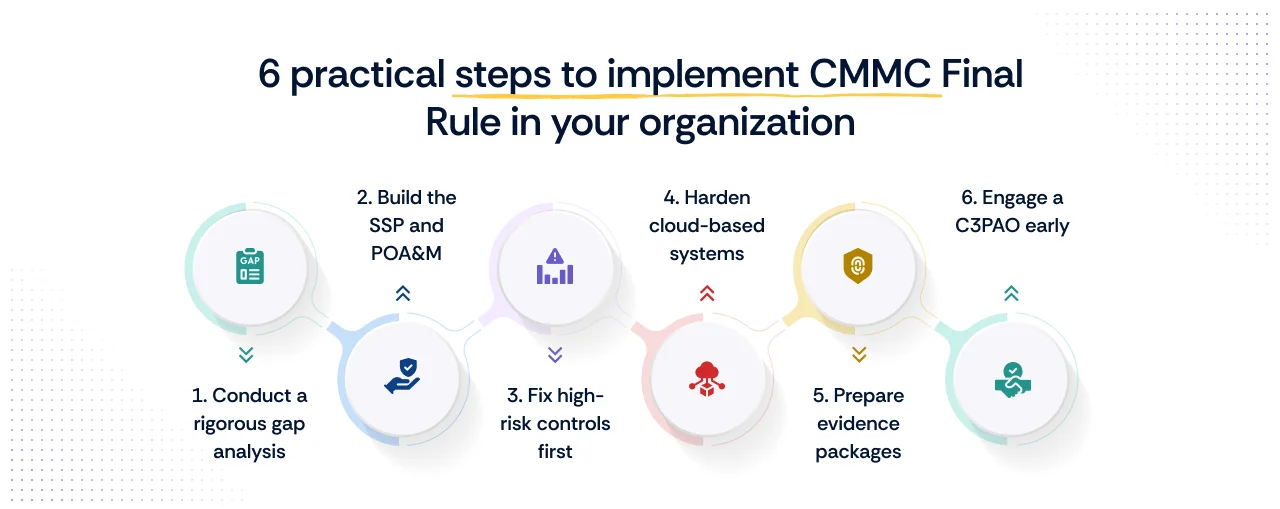
Achieving CMMC readiness is a marathon, not a sprint, and decisive action is required immediately to secure future contract eligibility. The final rule demands verifiable evidence, making thorough CMMC preparation steps crucial.
1. Conduct a rigorous gap analysis
The essential first step is a thorough NIST 800-171 gap analysis against NIST SP 800-171 Rev. 2 (the basis for Level 2). This assessment must detail every control discrepancy, assigning the appropriate weighted score to reveal the true depth of the compliance challenge.
2. Build the SSP and POA&M
The SSP is the authoritative document that details how every control is implemented. Simultaneously, create a comprehensive Plan of Action and Milestones (POA&M) to itemize any gaps, assigning ownership, resources, and, critically, setting hard deadlines that adhere to the 180-day CMMC limit.
3. Fix high-risk controls first
Prioritize controls weighted 5 points (e.g., encryption, multi-factor authentication) and those controls barred from the POA&M. Remedying these high-risk areas first ensures the foundation is sound and maximizes the initial compliance score.
4. Harden cloud-based systems
For organizations handling CUI, transitioning to specialized, hardened cloud environments like Microsoft 365 GCC High or AWS GovCloud is often necessary. These environments are architected to meet the stringent control requirements required by the government.
5. Prepare evidence packages
Assessors will not rely on your word; they require proof. Proactively gather and organize CMMC evidence, including screen captures of configuration settings, system logs, training records, and policy documents, and map them directly to the relevant NIST control.
6. Engage a C3PAO early
For organizations targeting Level 2, engaging an authorized C3PAO or an expert CMMC Registered Practitioner early in the process is invaluable. They can perform a readiness review, helping to define the correct scope and providing objective feedback to prevent costly remediation efforts later in the process.
Where Scrut fits in: Achieving CMMC automation
The CMMC Final Rule necessitates sustained, verifiable compliance, a task that often overwhelms contractors with documentation and manual evidence collection. The Scrut platform is engineered as a smart GRC solution to accelerate CMMC automation, transforming a daunting manual effort into a streamlined, continuous process.
Scrut's capabilities directly map to the Final Rule's rigorous demands:
- Continuous monitoring: Scrut provides real-time alerts when security controls drift out of compliance, ensuring the organization remains "Always Assessment Ready" and satisfying the rule’s continuous monitoring requirements.
- Documentation and POA&M automation: The platform offers pre-built, auditor-vetted policy and SSP builder templates for all CMMC levels. It also centralizes and tracks the status of all remediation tasks, acting as a dynamic POA&M management tool to enforce the critical 180-day remediation deadline.
- Automated evidence collection: Through deep integrations with over 70 cloud and IT services, Scrut automates the collection of logs, configurations, and artifacts, significantly reducing the manual effort required to compile CMMC evidence packages.
- Assessor collaboration: Scrut's Trust Vault provides a secure, single source of truth for all security posture data. Contractors can grant C3PAOs direct, restricted access, allowing assessors to efficiently review evidence packages and accelerate the audit timeline.
By leveraging compliance automation, Scrut empowers contractors to manage their risk posture proactively, reducing audit stress and enabling immediate focus on contract acquisition.
The CMMC final rule requires immediate, verifiable compliance to secure your future DoD contracts. Transform the complexity of NIST 800-171 into continuous readiness by leveraging the Scrut platform for CMMC automation and real-time evidence collection.
Frequently Asked Questions about the CMMC final rule
1. What is the main objective of the CMMC final rule?
The main objective is to shift Defense Industrial Base (DIB) cybersecurity from the previous self-attestation model to a mandatory, verifiable certification that is a condition for winning DoD contracts.
2. What are the three CMMC 2.0 maturity levels?
The three levels are: Level 1 (Foundational) for protecting Federal Contract Information (FCI), Level 2 (Advanced) for protecting Controlled Unclassified Information (CUI) based on NIST 800-171, and Level 3 (Expert) for protecting critical CUI against Advanced Persistent Threats (APTs).
3. When do CMMC requirements start appearing in contracts?
CMMC requirements began to be included in applicable DoD contracts starting on the rule effective date of November 10, 2025, marking the beginning of a multi-year, phased rollout.
4. What is the deadline for fixing security gaps (POA&M) after a Level 2 assessment?
Any outstanding security gaps permitted on a Plan of Action and Milestones (POA&M) must be fully remediated and verified within 180 days to achieve final CMMC Status.
5. What is the biggest difference between CMMC 1.0 and 2.0?
The model was streamlined from five levels to three, and the CMMC 2.0 framework directly aligns all Level 2 requirements with NIST 800-171 and allows for limited self-assessments at Level 1 and some Level 2 contracts.
6. What is the risk associated with the annual CMMC affirmation?
Submitting a false or inaccurate CMMC affirmation regarding compliance status exposes a contractor to significant legal liability, including potential penalties under the federal False Claims Act.