CMMC certification cost: Estimate your total compliance budget
If your business interacts with the Department of Defense (DoD), whether you are a prime contractor, a subcontractor, or part of the supply chain, you are already operating under a new, non-negotiable mandate: the Cybersecurity Maturity Model Certification (CMMC). CMMC is the Department of Defense’s (DoD) cybersecurity certification program that verifies whether Defense Industrial Base (DIB) contractors properly safeguard Federal Contract Information (FCI) and Controlled Unclassified Information (CUI) in line with standards like NIST SP 800-171. Simply put, compliance is quickly becoming the gatekeeper for future federal contracts.
But compliance comes with a price. For many organizations, the CMMC certification cost is not a single, clear-cut number; it is a complex, multi-year investment that can range from a few thousand dollars for a simple self-assessment to well over $200,000 for comprehensive, third-party certification.
This wide variance makes accurate budgeting a nightmare. In this complete breakdown, we demystify the investment required for CMMC 2.0. We will dissect the total cost into four distinct phases, from initial preparation through ongoing maintenance and, most importantly, isolate the five critical factors that determine where your organization lands on the cost spectrum. Understanding these variables is the key to creating a realistic budget and achieving compliance without financial surprise.
The CMMC cost breakdown: Four major categories
The cost of CMMC certification isn’t a one-time audit expense; it’s a multi-year investment covering readiness, remediation, assessment, and ongoing maintenance. For most small to mid-sized contractors, the estimated first-year expenditure for CMMC Level 2 ranges from $70,000 to $250,000, depending on your organization’s size, scope, and security maturity. Annual maintenance costs are typically lower, while Level 1 expenses are significantly less.
According to DoD estimates published in the Federal Register, small entities may spend $105,000 to $118,000 across a three-year certification cycle. However, these figures are illustrative averages, not fixed fees — actual costs vary widely based on your starting point and chosen assessment path (self-assessment vs. third-party audit).
For clarity, these costs can be broken down into four key phases, reflecting the major categories of investment over the certification lifecycle.
Here is the detailed breakdown by phases:
Phase 1: Readiness and preparation costs (The initial audit prep)
Phase 1 involves the critical, one-time financial commitment necessary to define the regulatory scope and establish the organization's initial security baseline. Effective management of this phase is crucial for preventing massive cost overruns in later stages.
- Regulatory scoping and asset inventory: The foundational step in cost control involves precisely defining which systems, applications, and personnel store, process, or transmit CUI. This segmentation effort minimizes the compliance footprint. This initial scoping process typically incurs costs ranging from $2,000 to $10,000, frequently being integrated into the broader assessment fee structure.
- Gap assessment and readiness review: This component requires a formal, comprehensive review, generally executed by a Registered Provider Organization (RPO). The RPO compares the current security environment against the 110 controls stipulated in NIST SP 800-171 and subsequently delivers a prioritized Plan of Action & Milestones (POA&M). The fee for this critical review is highly variable, ranging from $5,000 to $25,000, dependent upon the organization's size and network complexity.
- System security documentation development: Compliance mandates the creation of formal documentation, specifically the System Security Plan (SSP), along with supporting security policies and procedures. Outsourcing the development of these audit-ready artifacts to expert consultants typically incurs costs ranging from $10,000 to $35,000.
Phase 2: Implementation and remediation costs (The biggest investment)
Addressing the deficiencies identified in Phase 1, the Implementation and Remediation phase constitutes the largest variable expenditure, with costs determined by the organization's initial security maturity level.
- Technology and infrastructure modernization (Hard costs): This category encompasses the capital expenditure for acquiring and deploying new tools necessary to satisfy the 110 practices. Common requirements include the rollout of strong Multi-Factor Authentication (MFA), advanced Security Information and Event Management (SIEM) and Endpoint Detection and Response (EDR) solutions, and often migration to a specialized, compliant cloud environment, such as Azure GCC High. For organizations with low initial maturity, these technology purchases and deployments can escalate rapidly, costing between $20,000 and $150,000+.
- Internal resource allocation (Soft costs): Beyond direct purchasing, a substantial non-cash cost is incurred through the internal labor dedicated by IT staff, engineers, and management. This represents the cumulative weeks or months of time devoted to control implementation, configuration, and the gathering of necessary evidence for the assessment. This internal resource allocation must be accurately factored into the total compliance budget.
Phase 3: Formal assessment costs (The audit fee)
The Formal Assessment phase represents the mandatory validation component, a significant triennial expense required for all organizations subjected to a C3PAO audit.
- Certified Third-Party Assessor Organization (C3PAO) fee: This is the direct payment remitted to the C3PAO to conduct the official audit of the CUI scope, which may be performed on-site or virtually. C3PAO audit fees typically initiate at approximately $35,000 for a small, clearly defined CUI enclave and can exceed $75,000 for larger, more intricate environments.
- Department of Defense (DoD) assessment estimate: The Department of Defense has publicly provided total triennial assessment cost estimates for small entities, which cover the initial audit fee and subsequent annual affirmations. The DoD projects this total expense to be in the range of $105,000 to $118,000 over the complete three-year certification cycle.
Phase 4: Ongoing maintenance and recertification costs (The long game)
While certification is a one-time milestone, compliance necessitates continuous operational expenditure. Phase 4 costs are recurring, essential for maintaining certified status, control effectiveness, and preparing for the next audit cycle.
- Annual security license and subscription renewals: This recurring cost covers the renewal of all necessary security tools, including specialized SIEM, EDR, and compliant cloud service fees. This expense typically falls between $5,000 and $20,000+ per year.
- Continuous monitoring and internal audits: To ensure enduring compliance, controls must be continuously verified and evidence routinely gathered. Organizations often budget for this by allocating internal staff time or engaging an External Service Provider (ESP) on a retainer, with fees often starting between $1,000 and $3,000 per month.
- Mandatory training and personnel development: This budget line includes the required annual security awareness training for all users and role-based training for IT staff involved in CUI protection. Budgeting for this typically requires $1,000 to $5,000 per year.
- Triennial recertification financial reserve: Although the C3PAO audit (Phase 3) is a triennial event, responsible financial management dictates setting aside funds incrementally to absorb the entire cost of the next audit when it arrives in three years.
Key factors driving CMMC certification costs
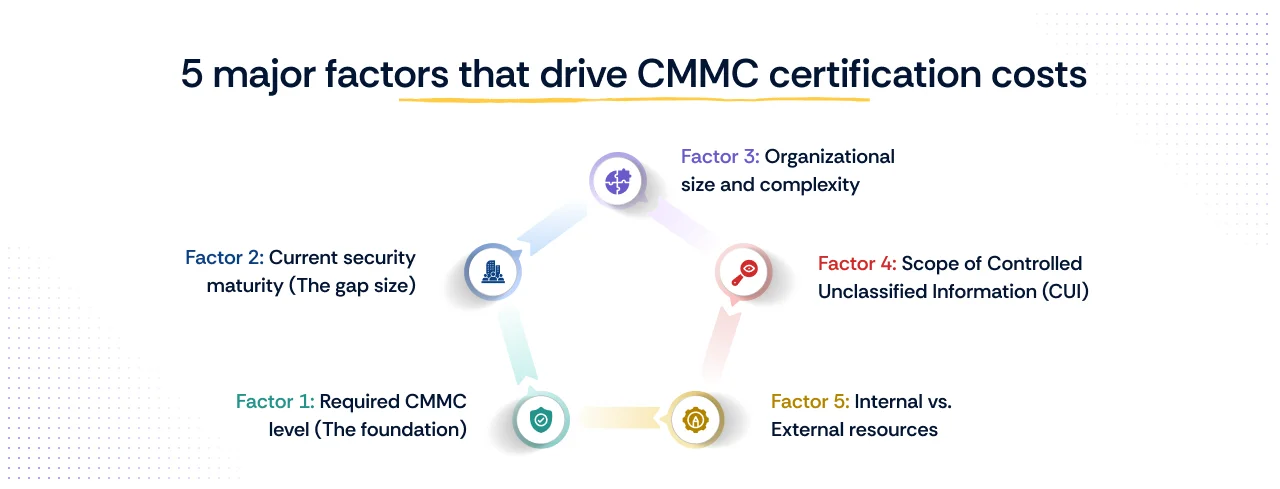
The wide cost ranges presented above are not arbitrary. They are primarily driven by four critical factors unique to every organization that handles CUI. Understanding these drivers is essential for accurate budgeting.
The following factors are the primary drivers of whether your organization falls on the high or low end of the cost spectrum.
Factor 1: Required CMMC level (The foundation)
The CMMC Level is the primary cost determinant. Level 1 (protecting FCI) is the cheapest and easiest. Level 2 (protecting CUI, based on 110 NIST 800-171 controls) is the most common and involves significant technical and financial investment. Level 3 (protecting against Advanced Persistent Threats) is the most expensive, often reserved for high-priority programs.
Factor 2: Current security maturity (The gap size)
The greater the gap between your current security environment and NIST SP 800-171, the higher your remediation costs will be.
- Low maturity: Organizations starting from scratch or lacking controls like MFA and centralized logging face significantly higher remediation costs, requiring major technology purchases.
- High maturity: Organizations compliant with ISO 27001 or SOC 2 will have lower costs due to overlapping security controls, requiring fewer technical upgrades.
Factor 3: Organizational size and complexity
These factors directly impact the number of devices and people that need securing.
- Size: More employees, endpoints, and devices mean more scope, more security tool licenses, and more labor time required for implementation and assessment.
- Complexity: Multiple geographic locations, complex supply chain relationships, or diverse, integrated IT systems increase the network complexity and, therefore, the cost dramatically.
Factor 4: Scope of Controlled Unclassified Information (CUI)
This is the most critical area for cost control. The scope defines the systems and assets subject to CMMC requirements.
- Broad scope: CUI spread across the entire organization is the most expensive path, forcing the entire network into compliance.
- Contained scope (The money saver): Limiting CUI to a small, isolated "enclave" (network segmentation) is the single most effective way to reduce implementation and assessment costs by minimizing the number of systems and personnel in scope.
Factor 5: Internal vs. External resources
Your reliance on outside expertise impacts the budget allocation.
- DIY (Internal): Choosing internal staff for gap analysis and documentation leads to lower consultant fees but imposes high internal labor costs, delays, and a potential risk of incomplete compliance.
- Consultant (External): Hiring an RPO or consultant means higher upfront fees but provides faster, more reliable implementation and proven expertise.
Strategies for budgeting and cost control
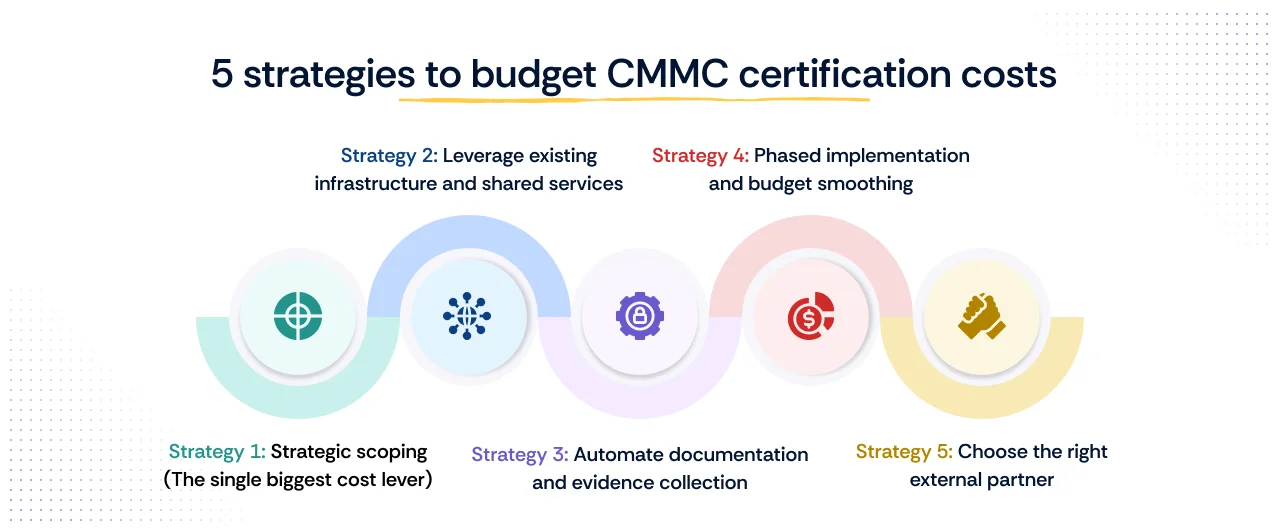
The sticker shock of CMMC Level 2 is real, but smart, strategic planning can mitigate the financial burden. The goal is to minimize the scope of the environment requiring certification and leverage existing resources where possible.
Strategy 1: Strategic scoping (The single biggest cost lever)
This is the non-negotiable first step. Compliance is required only for systems that store, process, or transmit CUI, plus systems that protect those systems. By isolating CUI, you drastically reduce the footprint subject to 110 controls.
- Network segmentation: Create a secure, segmented CUI enclave, often using a single cloud-based solution (like a dedicated Microsoft GCC High or AWS GovCloud instance).
- CUI-specific personnel: Limit the number of employees who have access to CUI. Fewer users in scope mean fewer licenses, less training, and less assessment time.
- CUI flow mapping: Document and enforce a clean, simple process for how CUI enters and leaves the organization, ensuring it never touches out-of-scope systems.
Strategy 2: Leverage existing infrastructure and shared services
Avoid buying new tools for every control if your existing stack can be repurposed or upgraded slightly.
- Maximize current tooling: Identify security tools you already own (e.g., firewall, MDM, antivirus) and document how they meet CMMC practices, even if the tools weren't originally purchased for that purpose.
- Cloud Service Provider (CSP) inheritance: If you use a compliant cloud service like Microsoft Azure or AWS, you can inherit many foundational controls (like physical security and environment hardening). This saves substantial remediation time and is accepted by C3PAOs.
- Shared services with Primes: If you are a subcontractor, investigate whether your prime contractor offers centralized security services, such as shared security monitoring (SIEM) or compliant cloud access, which can lower your direct tooling costs.
Strategy 3: Automate documentation and evidence collection
Manual evidence gathering and documentation updates are massive time sinks (soft costs). Compliance automation tools drastically reduce internal labor and speed up the audit process.
- Utilize compliance platforms: Invest in a Governance, Risk, and Compliance (GRC) or compliance automation platform, such as Scrut Automation, that specifically maps your existing security controls to the 110 NIST practices (CMMC Level 2) and beyond (Level 3). Platforms like Scrut help you track controls, manage risks, and ensure audit readiness through continuous monitoring.
- Auto-generate documentation: Use automation tools to maintain the SSP and POA&M. Automating document generation ensures consistency and reduces the expensive hours consultants or internal staff spend writing and editing.
- Streamline evidence: Set up automated connectors to your IT systems (e.g., endpoint management, cloud logs) to continuously collect and centralize audit-ready evidence (e.g., screenshots, logs, configuration settings). This efficiency reduces the audit time spent by the C3PAO, directly lowering their billed hours.
Strategy 4: Phased implementation and budget smoothing
Treat CMMC remediation as a multi-year IT modernization project, not a rush job. This allows you to spread the capital expenditure across budget cycles.
- Prioritize high-impact/Low-cost controls: Start with documentation, policy updates, and configuration changes (low-cost, high-impact). Defer major capital expenditures until later in the timeline.
- Break remediation into milestones: Structure your POA&M to address the most critical and expensive gaps in separate phases, allowing costs to be distributed over 12-18 months.
- Budget for triennial recertification: Divide the estimated $35,000 – $75,000 C3PAO fee by 36 months and set aside that amount monthly to ensure the triennial cost doesn't hit the budget all at once.
Strategy 5: Choose the right external partner
The initial investment in an experienced RPO can prevent massive costs later by eliminating failed audit attempts or misdirected technical spending.
- Vet for CMMC specificity: Do not hire a general IT consultant. Hire a RPO that focuses specifically on NIST SP 800-171/CMMC to ensure they know exactly what C3PAOs look for.
- Negotiate fixed-price agreements: For the Gap Assessment and Documentation phase, insist on fixed-price quotes rather than hourly billing to maintain budget control.
- Consider managed services: For Phase 4 maintenance, an ESP or Managed Security Service Provider (MSSP) specializing in CMMC can often be cheaper than hiring, training, and retaining a full-time, specialized internal CUI compliance officer.
How Scrut can slash CMMC certification costs
Compliance automation platforms are one of the most effective ways to mitigate the high soft costs of CMMC compliance (internal labor) and reduce the hard costs (consulting and audit fees). A platform like Scrut Automation is specifically designed to address the CMMC cost drivers across all four phases of the compliance journey.
1. Readiness and remediation (Phases 1 & 2)
- Faster documentation: Use Scrut's pre-built, auditor-vetted templates for your System Security Plan (SSP) and policies, drastically cutting down on expensive external consulting labor.
- Targeted remediation: Gain a continuous view of non-compliance to focus internal IT resources only on critical gaps, preventing wasteful technology spending.
2. Formal assessment (Phase 3)
- Centralized evidence: Automated deep integrations pull audit-ready evidence (logs, configurations) from your IT stack and present it to the C3PAO via an Assessor Portal.
- Minimized audit duration: By eliminating manual evidence gathering, Scrut significantly reduces the total audit duration, directly lowering the C3PAO's billed assessment hours.
3. Maintenance and recertification (Phase 4)
- Continuous monitoring: Automated monitoring detects control drift (e.g., disabled MFA) in real-time, preventing costly last-minute rework or failed audit attempts.
- Labor reduction: Automate up to 70% of continuous evidence collection and control checks, cutting internal labor (soft) costs and making the annual maintenance budget predictable.
Ready to transform your CMMC compliance from an operational headache into a streamlined, automated process? Schedule a demo and get a tailored quote today!
Frequently asked questions (FAQs) about CMMC costs
What is the total estimated cost of CMMC Level 2 certification?
The total first-year cost for CMMC Level 2 (C3PAO assessment track) for a small to medium-sized business typically ranges from $70,000 to $250,000+. This includes readiness, remediation, and the triennial audit fee.
How much does the C3PAO audit fee cost alone?
The direct triennial assessment fee charged by a Certified Third-Party Assessment Organization (C3PAO) typically ranges from $35,000 to $75,000 or more, depending on the size and complexity of your CUI scope.
Is CMMC a one-time cost or an ongoing expense?
CMMC is an ongoing expense. While the major C3PAO audit occurs every three years, you must budget annually for continuous monitoring, security tool licenses, maintenance, and training (Phase 4 costs, estimated at $10,000 – $40,000 annually).
Can small businesses self-certify for CMMC Level 2?
Some CMMC Level 2 contracts permit an annual self-assessment (for non-prioritized acquisitions), while others require a triennial C3PAO assessment. However, businesses cannot self-certify their compliance — even a self-assessment must be formally attested by a senior company official and submitted to the Department of Defense through the SPRS. If your organization handles CUI for a prioritized acquisition or other sensitive programs, you’ll be required to undergo the more rigorous, third-party C3PAO audit.
What is the biggest factor that drives the cost up?
The biggest factor is the scope of Controlled Unclassified Information (CUI). If CUI is not isolated, the entire company network falls into the certification scope, dramatically increasing technology, labor, and audit costs.
How long does it take to become CMMC certified?
The preparation and certification process typically takes 6 to 18 months, depending on your starting security maturity. The official C3PAO assessment alone can take a few weeks to a few months.


Related Posts